
Modern Minimalist Wardrobe Essentials 2026: The Complete Guide
Last Updated: November 5, 2026
Quick Summary
A minimalist wardrobe is a tight, intentional collection of versatile pieces that mix freely, so getting dressed takes minutes instead of an hour. Build one by decluttering first, setting two base neutrals plus one accent, and following a 30 to 35 piece capsule checklist.
- A capsule wardrobe is a defined set of usually 30 to 40 pieces that all work together.
- The 2026 capsule checklist covers roughly 30 to 35 pieces across five categories.
- Most capsules run heavier on tops than bottoms because tops show wear faster.
- Concentrate spend on outerwear, blazers, footwear and tailored trousers for the lowest cost-per-wear.
- Above roughly 2 percent stretch, garments tend to lose recovery and bag at the knee.
Table of Contents
- What Modern Minimalist Wardrobe Essentials Actually Mean in 2026
- How to Build a Capsule Wardrobe From Scratch
- Your 2026 Minimalist Capsule Wardrobe Checklist
- Essential Tops and Basics: The Crisp White Shirt and Neutral Knitwear
- Tailored Bottoms, Structured Blazers and Straight-Leg Denim
- Fabric Composition and Care: Why Breathable Fabrics and Cost-per-Wear Matter
- Winter Minimalist Wardrobe Essentials 2026
- Summer Minimalist Capsule Wardrobe 2026
- Body Type Customization, Budgeting and Remote Work
- Subscribe to SEYMONE and Start Your Capsule Collection
- Frequently Asked Questions
What Modern Minimalist Wardrobe Essentials Actually Mean in 2026
A modern minimalist wardrobe is a tight, intentional collection of versatile pieces that mix freely, so getting dressed takes minutes instead of an hour. The shift away from fast fashion has made this approach mainstream, and the Ellen MacArthur Foundation's work on circular fashion explains why disposable clothing is losing ground with thoughtful buyers.
The distinction matters more than most guides admit.
Minimalist Wardrobe vs Capsule Wardrobe
A minimalist wardrobe is a philosophy: you own less, choose better, and reject trend cycles. A capsule wardrobe is the method: a defined number of pieces, usually 30 to 40, that all work together. Minimalism is the mindset; the capsule is the spreadsheet. Most people need the second to achieve the first.
How to Build a Capsule Wardrobe From Scratch
Building a capsule wardrobe starts with subtraction, not shopping. Most people own far more than they wear, and the fastest route to a workable capsule is removing what you never reach for before adding anything new.
Start With a Wardrobe Audit and Decluttering
Pull everything out. Sort into three piles: wears weekly, wears rarely, never wears. Be honest about the third pile; sentimental items belong in storage, not your daily rotation. Wardrobe decluttering is uncomfortable the first time and liberating by the third.
- Remove anything that doesn't fit today
- Set aside damaged pieces for repair or donation
- Count what remains in each category
- Note the gaps (missing blazer, no neutral knitwear)
Set Your Neutral Palette and Fit Rules
Pick two base neutrals and one accent. Black and cream with olive, or navy and grey with camel. Then define your fit rules: where hems should land, how trousers should break, how a structured blazer should sit at the shoulder. Write these down. They stop impulse buys that never integrate.
Your 2026 Minimalist Capsule Wardrobe Checklist
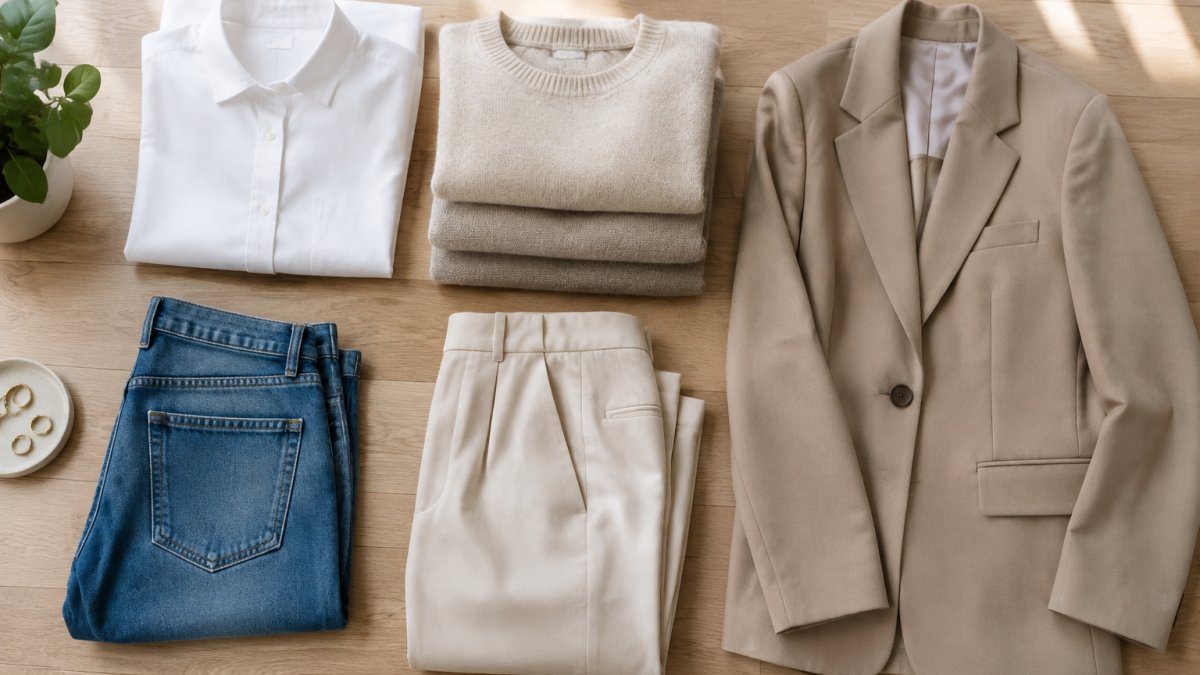
A working 2026 minimalist capsule wardrobe checklist covers roughly 30 to 35 pieces across tops, bottoms, outerwear, shoes and accessories. The exact count matters less than the ratio: most capsules run heavier on tops than bottoms, because tops show wear faster and carry more of the visual variety.
| Category | Pieces | Priority |
|---|---|---|
| Tops and basics | 8-10 | Crisp white shirt, neutral knitwear |
| Bottoms | 4-5 | Tailored trousers, straight-leg denim |
| Outerwear | 3-4 | Structured blazer, versatile layers |
| Footwear | 3-4 | Loafers, clean sneakers, boots |
| Accessories | 4-6 | Minimalist jewelry, leather belt, tote |
Essential Tops and Basics: The Crisp White Shirt and Neutral Knitwear
The crisp white shirt is the single most useful piece in a minimalist wardrobe, and it is also the hardest to buy well. Lower-quality versions can go translucent at the shoulder and yellow under the arms over time. Look for a dense cotton poplin with a matte finish, a collar that holds its shape without fusing, and a hem long enough to tuck.
Neutral knitwear does the rest of the work. A fine-gauge merino crew in oatmeal or charcoal covers smart casual days, layering under a blazer, and travel. Buy two, not five.
Tailored Bottoms, Structured Blazers and Straight-Leg Denim
Tailored fit is what separates a minimalist wardrobe from a baggy one. Straight-leg denim in a rigid or low-stretch denim holds its line and pairs with everything from loafers to clean sneakers. Skip heavy distressing; it dates fast and fights the clean lines you're building.
A structured blazer is the piece that makes the whole system read as intentional. Shoulder seam at the edge of your shoulder, one or two buttons, no padding beyond structure. Tailored trousers in a wool blend or heavy cotton complete the base. These three items, worn together or split apart, handle most professional situations.
Fabric Composition and Care: Why Breathable Fabrics and Cost-per-Wear Matter
Fabric composition decides whether a garment survives three years or three washes, and it is the single most overlooked variable in minimalist wardrobe planning. Most guides stop at aesthetics; the technical layer is where a capsule actually holds together. Cost-per-wear is the honest metric: divide the purchase price by the number of times you will realistically wear it. A shirt worn twice a week for two years beats a cheaper one that pills after a month, every time.
Breathable fabrics matter more than most shoppers realize. Natural fibers like cotton, merino wool and linen regulate temperature and resist odor, which means fewer washes and longer life. But "natural" is not a quality guarantee on its own. The weave, the fiber length and the finishing matter as much as the fiber name on the label.
How to Read a Fabric Label Like an Editor
Before the price tag, check the composition tag. A few practical rules most practitioners use:
- Cotton poplin: holds shape, wrinkles, easy care. Look for a dense, matte weave; hold it to the light and check for transparency at the shoulder. Long-staple cotton (often labeled Pima or Supima) pills less and softens rather than thins.
- Merino wool: temperature-regulating, odor-resistant, hand wash or wool cycle. Fine-gauge merino layers under a blazer without bulk; coarser gauges are for outer layers. Check for a tight knit, loose merino snags and holes at friction points.
- Linen: breathable, creases by design, softens with age. Heavier weights (often described as "washed" or "garment-dyed") drape better and crease less aggressively than thin linen.
- Viscose and rayon blends: drape well, pill faster, check the percentage. A high viscose content in knitwear is the most common cause of pilling complaints, and no amount of careful washing fixes a fiber that was never going to hold up.
- Elastane and stretch blends: useful in denim and trousers for movement, but above roughly 2 percent stretch, the garment tends to lose recovery and bag at the knee. Rigid or low-stretch denim holds its line longer.
Watch out: a "wool blend" can contain as little as 20 percent wool and still carry the word on the front of the tag. Read the percentage breakdown, not the marketing name.
Care Routines That Extend Life
Care is where cost-per-wear is won or lost. A few mechanisms matter more than any product:
- Wash less, air more. Merino and linen in particular benefit from airing between wears; odor-resistant fibers recover with ventilation rather than detergent.
- Cold water and low agitation slow fiber fatigue and color loss. Heat is the enemy of elastic recovery and of wool's structure.
- Dry flat, not hanging, for knits. Hanging wet knitwear stretches the shoulder and hem out of shape permanently.
- Fold, don't hang, heavy knits and structured blazers; hanging distorts the shoulder line over time.
- Store with cedar or lavender rather than mothballs; the smell of mothballs is hard to remove from natural fibers.
The Cost-per-Wear Calculation in Practice
Run the math before you buy. A blazer at a higher price worn twice a week for three years lands at a low cost-per-wear; a trend piece worn five times lands high no matter how cheap it was. The practical takeaway for a 2026 capsule is to concentrate spend on the pieces with the highest wear frequency and the longest expected life: outerwear, blazers, footwear and tailored trousers. Tops and knitwear wear out faster, so buy well but do not over-invest there. This is the budgeting logic that connects fabric choice to the capsule's overall economics.
Winter Minimalist Wardrobe Essentials 2026
Winter minimalist wardrobe essentials in 2026 come down to layering, not bulk. A merino base layer, a neutral knit, tailored trousers in a heavier cloth, and one good coat handle almost every cold day. Choose a coat in a classic silhouette, single-breasted wool or a clean trench, in your base neutral so it works over everything.
Versatile layers beat one heavy piece. A fine knit under a blazer under an overcoat traps more warmth than a single thick sweater and looks considerably sharper indoors.
Summer Minimalist Capsule Wardrobe 2026
A summer minimalist capsule wardrobe in 2026 leans on linen, lightweight cotton and a tighter color range. Two linen shirts, one pair of tailored shorts, a straight-leg light-wash denim, one knit tee in a neutral, and clean sandals or loafers cover most of the season. Monochromatic dressing works hardest in summer: one tone head to toe reads deliberate and needs no accessorizing.
Keep fabrics breathable and light in color. Dark linen shows sweat and creases badly in heat.
Body Type Customization, Budgeting and Remote Work
The same capsule looks different on every body, and that is the point of fit rules rather than a fixed shopping list. Body type customization means adjusting proportions, not avoiding categories. Most practitioners find that a handful of proportion rules cover the majority of frames:
- Shorter torso: higher-rise trousers and a slightly cropped or tucked top lengthen the leg line. Avoid long, untucked shirts that cut the body in half.
- Longer torso: mid-rise trousers and a hip-length knit balance the proportions; a tucked shirt with a belt adds a visual break.
- Broader shoulders: a softer, less structured blazer shoulder and a V-neck or open collar draw the eye inward. Avoid strong shoulder padding.
- Narrower shoulders: a structured blazer with a defined shoulder seam adds presence; a boat neck or horizontal detail on tops widens the line.
- Curvier hips: straight-leg and tailored trousers with a clean waistband skim rather than cling; a longer blazer hem balances the silhouette.
- Straight or athletic frames: layering and texture add dimension; a belted waist or a slightly tapered trouser creates shape.
Buy for your frame, then tailor. A hem taken up and a waist taken in are inexpensive relative to the garment and transform how a piece reads. Fit rules written down at the start of the capsule stop impulse buys that never integrate.
Capsule Wardrobe Budgeting and Investment Pieces
Capsule wardrobe budgeting works best as a yearly figure split across two buying windows, not a monthly spend. A practical save-versus-splurge breakdown for a 2026 capsule:
- Splurge: outerwear, blazers, footwear and tailored trousers. These carry the most wear, define the silhouette and last longest. Fabric quality and construction show most here.
- Mid-range: knitwear and denim. Good merino and rigid denim are worth the step up; the difference in pilling and recovery is visible within a season.
- Save: basic tees, lightweight tops and trend-adjacent accessories. These wear out fastest and are the easiest to replace without disrupting the capsule.
A common pattern is to set the yearly figure first, allocate the splurge categories, then fill the remainder with save-tier basics. Pricing varies widely across the market, so check each brand's website for current figures.
Capsule Wardrobe for Remote Work and Smart Casual Days
Remote work changed the capsule's center of gravity. The pieces that earn their place now are the ones that work on a video call and in a room: a crisp white shirt, a fine knit, tailored trousers with a clean waistband, and one structured blazer for the days that matter. Smart casual is the default dress code, and it rewards neutral knitwear over graphic tees.
The Zoom-ready minimalist aesthetic has its own rules. On camera, the frame shows roughly the chest to the waist, so collar shape, neckline and shoulder line do most of the work. A collar that holds its shape, a fine-gauge knit in a solid neutral, and a structured shoulder read deliberate on screen. Busy prints and fine stripes can shimmer or moiré on video; solid neutrals and subtle texture are safer. Below the frame, comfort matters: a clean waistband and a trouser that works seated for hours beats a stiff tailored pair worn only for calls.
A hybrid-week capsule typically needs two or three "camera" tops, one blazer, two trousers that work seated and standing, and one pair of shoes that transitions from home desk to office. That is a smaller, more specific list than a traditional office capsule, and it is where most 2026 buyers are actually shopping.
This is where SEYMONE fits naturally. Our Premiére Collection is built around exactly these pieces, and our guidance on building a functional wardrobe matches what we hear from customers: they want fewer, better items they can rely on.
Subscribe to SEYMONE and Start Your Capsule Collection
SEYMONE curates modern apparel for women and men, with exclusive releases like the Premiére Collection and a streamlined shopping experience. Subscribe to SEYMONE to follow new arrivals and upcoming collections.
Frequently Asked Questions
What are the essential pieces in a minimalist wardrobe for 2026?
Most minimalist wardrobes centre on a crisp white shirt, neutral knitwear, straight-leg denim, tailored trousers, a structured blazer, a versatile coat and one pair of clean leather shoes. These cover smart casual and formal days with styling versatility. Add versatile layers and a monochromatic base so pieces mix freely. A capsule checklist helps you confirm each item earns its place before you buy.
How many pieces should a minimalist capsule wardrobe have?
A workable starting point is 25 to 40 pieces including tops, bottoms, outerwear, footwear and accessories. The exact number matters less than how often you wear each item. Track your wardrobe rotation for a month; if a piece sits unworn, it is not essential. A smaller capsule of around 30 pieces usually produces more outfits than a full closet because every item pairs with the rest.
How do you build a minimalist wardrobe from scratch?
Start with a wardrobe audit: pull everything out, sort by how often you wear it, and declutter what you skip. Choose a neutral palette, set fit rules for your body type, then buy in order of need rather than trend. Focus first on essential basics, then add investment pieces like a structured blazer. A capsule checklist keeps you from overbuying along the way.
Is a capsule wardrobe the same as a minimalist wardrobe?
They overlap but are not identical. A minimalist wardrobe is a mindset: fewer, better pieces with clean lines and a calm aesthetic. A capsule wardrobe is a method: a defined set of items that all work together for a season or year. Most people use capsule planning to reach a minimalist aesthetic, so the two approaches reinforce each other.
How can I adapt a minimalist wardrobe for winter and summer?
Keep the same base pieces and swap the layers. Winter minimalist wardrobe essentials include neutral knitwear, a structured coat and breathable base layers; summer calls for lighter fabrics, a crisp white shirt and straight-leg denim in a lighter weight. Store off-season items to keep your wardrobe rotation tight, and only add pieces that work across both seasons.
How do you create more outfits with fewer clothes?
Stick to a neutral palette so every top works with every bottom, then use versatile layers and accessories to change the look. A structured blazer over a crisp white shirt reads formal; the same shirt with straight-leg denim reads relaxed. Monochromatic dressing also multiplies combinations. Fewer pieces in a tight colour range produce more outfits than a large, mismatched closet.

